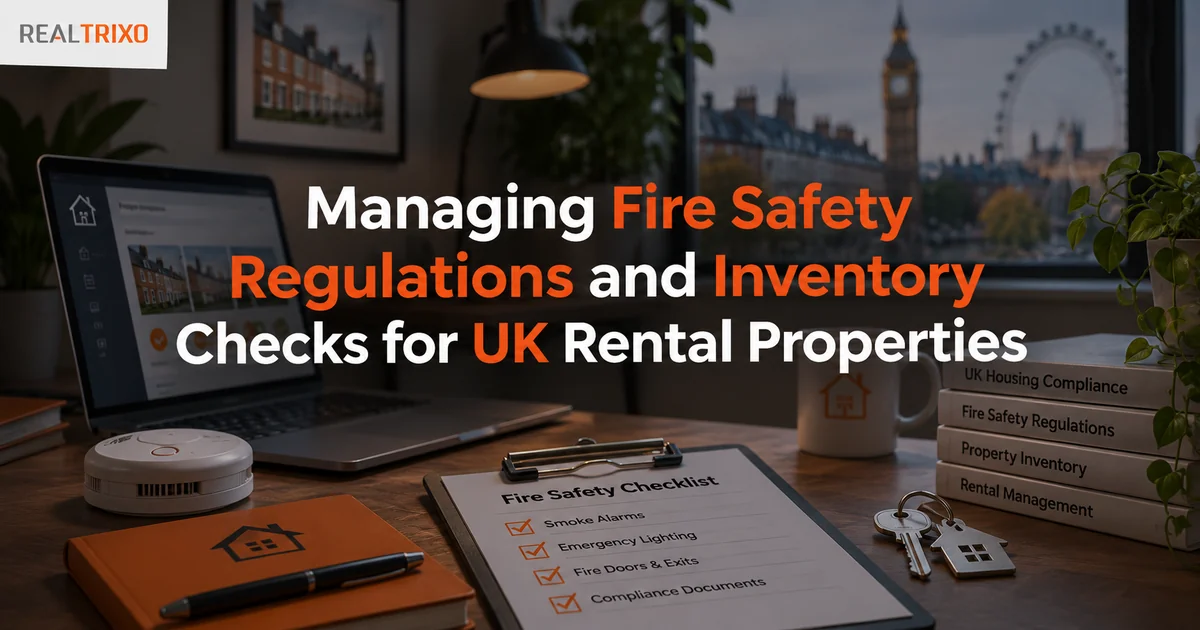
Being a Briton landlord comes with big responsibilities. You need to follow fire safety regulations to keep your tenants safe and yourself out of legal trouble. Under the Regulatory Reform (Fire Safety) Order 2005, you must install working alarms and clear escape routes, etc.
Otherwise, you might face massive fines of up to £5,000 (or worse) for non-compliance. Talking about inventory checks, they serve as your insurance policy. They prove your property’s condition and verify that those safety features actually work on day one.
Wondering how to manage fire safety regulations and inventory checks? Explore this detailed guide here!
Key Fire Safety Regulations for Landlords
Ignoring these regulations can turn bad while owning rental properties in the UK. You might face unconditional court fines, harsh council enforcement, and a completely invalidated insurance policy that leaves you paying for damages out of your pocket. To avoid them, stay compliant with these regulations:
Smoke Alarms
Smoke alarms are your property’s 24/7 security guards. And since 1 October 2022, they are non-negotiable legal lifesavers under smoke alarm regulations. As a landlord, you are legally required to set at least one smoke alarm on every single storey of your property that features habitable living space.
To maximise their life-saving potential, mount them high on the ceiling in central “circulation hubs” like hallways or landings. You must turn strict compliance into bulletproof protection. It means you must test and prove alarms work on day one of a new tenancy.
Because your tenants take over the watch by testing them annually. Double down on safety by asking your gas engineer to inspect the alarms during their annual safety check.
Carbon Monoxide (CO) Alarms
Apart from smoke, carbon monoxide (CO) alarms are a strict legal mandate for the private rented sector. Every single room featuring a fixed fuel-burning appliance, such as a gas boiler, water heater, or wood-burning stove, must be protected by a CO alarm.
Though decorative, blocked-off fireplaces are exempt. To ensure they actually save lives, you must install them strictly by the law, usually at head height and positioned 1 to 3 meters away from the fuel source.
While tenants should test them annually, you can add an extra layer of armour by asking your gas engineer to check the CO alarms during the annual gas safety inspection. Remember, landlords are entirely responsible for repairing or replacing faulty units.
Finally, protect your future self by logging the alarm's expiry date in your calendar or property management software the moment it is installed, ensuring you never miss a replacement window.
Furniture Standards
Every piece of furniture or furnishing you supply as a landlord must meet strict, legal fire safety standards. Under the Furniture and Furnishings (Fire Safety) Regulations, your provided items must be crafted from fire-resistant materials capable of passing cigarette and match ignition tests.
Spotting compliance is straightforward. Look for the manufacturer's permanent, non-detachable fire safety label stitched into the item. While certain elements, like the external decorative covers of pillows, cushions, and mattresses, have specific structural exemptions from permanent outer labelling, their internal fillings must still be fire-retardant.
Going above and beyond minimum requirements by sourcing fully certified BS7177 beds and mattresses is the best way to secure your investment.
Clear Escape Routes
When it comes to emergencies, a clear exit path is the line of defence. As a landlord, you are legally responsible for ensuring tenants have uninterrupted access to a safe escape route at all times, whether that means an internal hallway or an external fire escape.
To guarantee these routes remain usable during a crisis, they must feature emergency lighting and be structurally framed by fire-resistant floors and walls.
Fire Risk Assessments (FRAs)
Under Section 156 of the Building Safety Act 2022, it is a legal mandate for any property that isn't a single private dwelling. These evaluations hunt down potential fire hazards before they strike, laying out the exact precautions you need to take to completely protect your asset and your tenants.
- To keep your legal defences flawless, timing is everything. For standard properties, you should review the assessment every two years and fully update it every four years.
- If you manage an older building or one standing over three storeys high, up the ante by reviewing it annually and updating it every three years.
While there is no rigid, mandatory method to conduct one, the savviest landlords lean on a brilliant insider resource. Most local fire and rescue services provide free home visits through their Safe and Well initiative to spot risks, check smoke alarms, and help map out escape plans. Leveraging professional help costs you nothing, but it perfectly secures your compliance and absolute peace of mind.
Electrical and Gas Checks
Ensuring electrical installations are safe is your primary defence against electrical fires. It is the single most frequently reported fire claim for landlords. Since the phased regulations became fully mandatory for all tenancies on 1 April 2021, landlords must have electrical wiring, sockets, and fuse boxes inspected and tested by a qualified and competent professional at least every five years.
Once the inspection is complete, you are legally required to hand over a copy of the electrical safety report to your tenants, as well as to your local authority if they request it. Keeping these components in pristine condition doesn't just satisfy the law; it directly protects your property from the devastating, costly impact of electrical blazes.
HMO & High-Rise Rules
Managing an HMO or a shared building takes fire safety to the premier league. It’s where strict rules meet ultimate property protection. To keep multiple households safe under one roof, your first line of defence is blocking the flames.
You must install heavy-duty, certified fire doors with automatic self-closing hinges on all high-risk rooms, like shared kitchens, stairwells, and main hallways. In a large shared home, a small fire can go unnoticed until it’s too late.
That is why you need an interlinked, mains-powered alarm system. The moment a single sensor smells smoke in the basement, every single alarm in the building screams to give everyone maximum exit time. Don't forget to stock shared kitchens and corridors with fire blankets and extinguishers so small flare-ups can be snuffed out instantly.
Finally, if your building is on the taller side, the Fire Safety (England) Regulations 2022 mean you must check flat entrance doors regularly, put up clear navigation signs for emergencies, and hand over your property's floor plans directly to the local fire brigade. It sounds like a lot of paperwork, but it completely shields your tenants' lives and renders your business legally bulletproof.
How to Integrate Fire Safety into Inventory Checks?
If you want to legally protect your deposit claims against property damage that you handed over a perfectly safe, law-compliant home on day one. Ensure you follow these inventory checks:
Log Alarm Conditions
Don't just tick a box. For every single smoke and carbon monoxide (CO) alarm, your inventory report should explicitly state its exact location (e.g., "Ceiling, first-floor landing"), the brand, and confirmation that it is securely mounted.
Inventory Action: Explicitly state in the check-in report: “Smoke alarms on Floor X and Floor Y tested and working on [Date].” Have the tenant counter-sign this exact line.
Photograph Fire Labels
For every piece of luxury furniture and soft furnishing you provide, your inventory report must include a crisp, close-up photograph of its permanent fire safety label to prove it meets UK flame-retardant standards.
Inventory Action: Clearly state in the check-in report: “Permanent fire safety labels present, intact, and photographed on [Item Name/Location] on [Date].” Then, ask the tenant to counter-sign this exact line to verify that the compliance tags are fully present and have not been removed.
Track Extinguishers & Blankets
For every fire extinguisher and fire blanket you provide, your inventory report must state its exact location, verify the pressure gauge is in the green zone, and confirm the service history or expiry date is fully visible.
Inventory Action: Check-in reports should state “Fire extinguisher and fire blanket checked, unexpired, and unobstructed in [Location] on [Date].” Make the tenant counter-sign this exact line to acknowledge they know exactly where this life-saving equipment is located and that it is ready for emergency use.
Inspect Fire Doors & Exits
For every fire door and designated exit route in the property, your inventory report must confirm that the automatic self-closing mechanisms snap firmly into place, the smoke seals are intact, and the entire escape path is completely free of obstructions.
Inventory Action: State in the check-in report: “All fire doors tested, self-closers fully operational, and exit routes verified completely clear on [Date].” Then, put a tenant sign on it.
Get Tenant Sign-Off
On move-in day, your inventory report must culminate in a dedicated, legally binding declaration where the tenant explicitly confirms they have witnessed the live safety tests, inspected the compliance labels, and understood the property's emergency procedures.
Inventory Action: You must state “I confirm that all smoke/CO alarms, fire doors, and safety equipment have been demonstrated to me in full working order, and I accept responsibility for maintaining clear exit routes as of [Date].” And ensure an unshakeable, bulletproof paper report that shields you from future liability, signed by the tenant.
Compliance Checklist for Routine Mid-Tenancy Inspections
While tenants are expected to test alarms monthly during their tenancy, landlords should perform routine physical property inspections (typically every 3 to 6 months) to catch overlooked hazards.
- Alarms: Press the test buttons on all smoke, heat, and CO alarms to verify audio alerts work.
- Escape Routes: Confirm that hallways, communal entrance points, and external escape pathways are free of tenant belongings, bikes, or rubbish.
- Fire Doors: Inspect fire doors in HMOs to ensure self-closing mechanisms snap shut completely and that tenants haven't propped them open with wedges.
- Hazards near Ignition Points: Check that no combustible items like tea towels, paper, or cleaning chemicals are stored next to boilers, cookers, or fuse boxes.
- Visual Electrical Checks: Look for overloaded extension leads, daisy-chained sockets, or visibly frayed wiring on appliances.
- Log Everything: Keep a written and signed log of every inspection, noting the exact date and any corrective actions taken to maintain an unbroken paper trail.
Conclusion!
Managing fire safety and inventory checks isn't just about avoiding massive fines. It helps you secure your investment and your tenants' lives. By securing airtight proof on moving day and keeping your property compliant, you protect yourself from legal trouble and ensure your insurance stays valid. Stay proactive, document everything, and turn safety into your business advantage!