The Renters' Rights Act 2025 has changed how private renting works in England, creating new responsibilities for landlords and letting agents. Since 1 May 2026, most private sector assured tenancies have moved to an assured periodic tenancy model, while section 21 no-fault evictions have been abolished. Agents also need to manage new requirements around rent, tenancy information, pets, discrimination, notices, complaints, and record-keeping.
For letting agencies, compliance is no longer something that can depend on spreadsheets, inbox searches, paper files, or individual staff members remembering important dates. A connected lettings technology stack can make compliance processes more consistent while reducing repetitive administration.
Here is how agencies can build a practical tech stack for Renters' Rights Act Compliance.
What Does the Renters' Rights Act Mean for Letting Agents?
The Act applies to private rented housing in England and introduced major changes from 1 May 2026. Existing assured shorthold tenancies generally became assured periodic tenancies, while new private-sector tenancies are also generally periodic rather than having a fixed end date. term
The Act also introduced important changes involving:
- Rent increases and rental bidding
- Possession and eviction procedures
- Tenant requests to keep pets
- Protection against certain rental discrimination
- Written tenancy information
- Tenant communications and records
- Enforcement by Local Authorities
For example: most landlords and agents were required to provide tenants with the government's official Renters’ Rights Act Information Sheet by 31 May 2026. The official guidance states that failing to provide it could result in a fine of up to £7,000.
This creates a clear need for technology that can help agents organise documents, automate reminders, maintain records, and create an accessible audit trail.
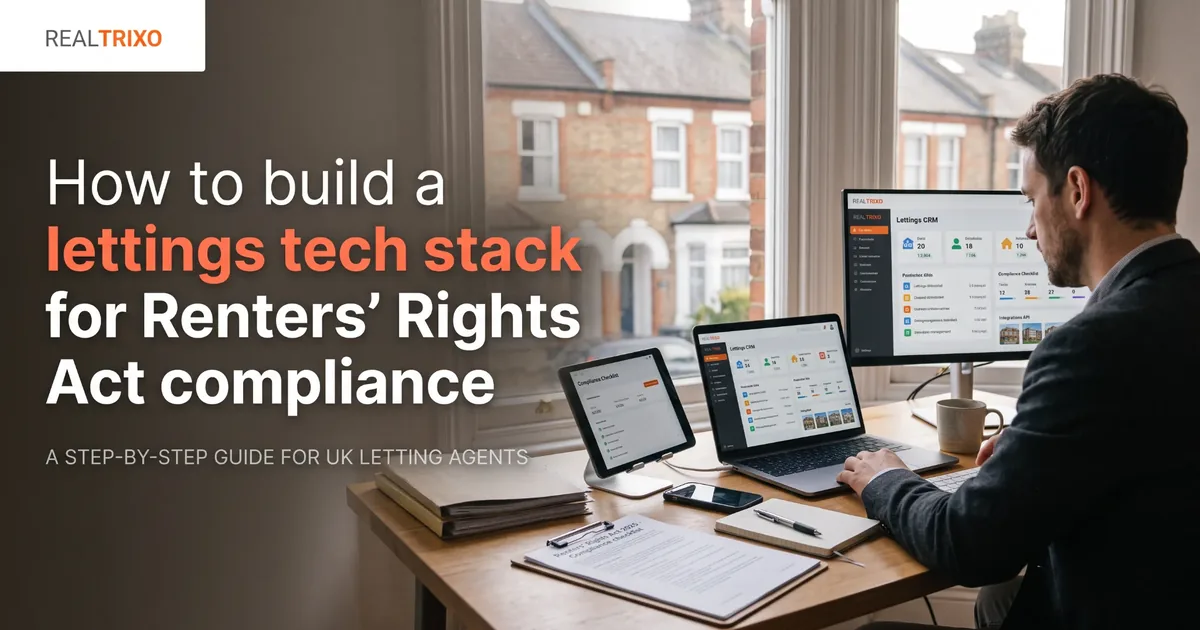
Start With a Central Lettings CRM
The foundation of your tech stack should be a central lettings CRM or property management platform.
Instead of keeping landlord information in one system, tenant messages in another, documents in shared folders, and important dates in spreadsheets, your CRM should provide a central record for each property and tenancy.
A suitable system should allow your team to manage:
- Property and landlord information
- Tenant details
- Tenancy records
- Documents and certificates
- Communications
- Rent information
- Maintenance requests
- Compliance dates
- Notes and activity history
The goal is simple: when a team member needs to understand what has happened with a property or tenancy, they should be able to find the relevant information without searching across multiple disconnected platforms.
Add Digital Document Management
Documentation is a part of compliance. Your technology stack should make it easy to store tenancy agreements, notices, certificates, inspection reports, correspondence, and other relevant documents against the property or tenant.
Digital document management can also reduce the risk of using templates. For example, when legislation or internal procedures change, your team can work from approved templates rather than relying on old documents saved on individual computers.
For existing written tenancies affected by the 2026 reforms, the government stated that landlords did not generally need to replace the existing written agreement. The official Information Sheet needed to be provided by the relevant deadline.
Your system should therefore be able to record what was sent to whom, when, and how.
Build Automated Compliance Reminders
One of the benefits of property technology is automation. When teams manage homes, they face thousands of compliance dates. Relying on memory is risky.
Your stack should provide reminders for items such as:
- Gas safety checks
- EPC renewals
- Electrical safety checks
- Property inspections
- Tenancy‑related deadlines
- Rent reviews
- Notice periods
- Insurance renewals
- Licence dates
- Other agency‑specific compliance tasks
Instead of asking staff to read spreadsheets, automated workflows can flag actions that are coming up before they become urgent.
This does not replace judgement. Instead, it gives your team a system to spot what needs attention.
Connect Tenant Referencing and Onboarding
Tenant onboarding can include checking identities, getting references, looking at affordability, and gathering documents. Using systems for each step can lead to repeating the same work over and over.
Linking referencing and onboarding tools with the property management system helps staff see which steps have been done and what information is still missing. Technology can also make sure agencies follow their processes in the same way every time.
This is very important because the Renters’ Rights Act brought in protections against rental discrimination. Official guidance says that landlords and letting agents should not treat people unfairly just because they get benefits or have children.
Add Digital Maintenance Management
Maintenance is another area where connected technology can improve record-keeping. Tenants can use an online portal to report issues, upload photographs, and receive updates. Agents can then assign jobs to contractors and track progress from the same system.
A digital maintenance record can show:
- When the issue was reported
- What the tenant reported
- Communication between parties
- Contractor appointments
- Work completed
- When the issue was resolved
This provides greater visibility and reduces reliance on individual emails or handwritten notes.
Improve Communication Tracking
Tenant communication must be reachable by authorised agency members, rather than staying only in personal inboxes.
A connected communication system can help teams keep records of emails, messages, notices and updates that matter.
For example, if a tenant raises a repair issue, staff must be able to review the conversation and see which actions have already been taken.
Centralised communication also makes staff handovers easier because a new team member can quickly see the history of a tenancy.
Maintain a Clear Audit Trail
A good lettings tech stack should record important actions automatically. An audit trail can show when documents were uploaded, communications were sent, notices were created, inspections were completed, or tenancy information was updated.
This can help agencies understand the history of a tenancy and locate relevant information when questions or disputes arise. The government has also provided enforcement measures for breaches of relevant provisions, making accurate records an important part of operational risk management.
Make Your Systems Work Together
Adding more software does not automatically create a better tech stack. If every application operates separately, staff may still spend hours copying information between platforms.
The goal should be integration:
For example:
| Technology | Main Purpose |
| Property management system | Properties and tenancies |
| Compliance software | Deadlines and checks |
| Document management | Agreements and records |
| Referencing software | Tenant onboarding |
| Maintenance software | Repairs and contractors |
| Inspection software | Property inspections |
| Accounting software | Rent and financial record |
| Communication tools | Tenant and landlord contact |
Review Your Tech Stack Regularly
Compliance technology should be reviewed as regulations and business processes change. Agencies should regularly check whether their software, templates, workflows, integrations, and reminders reflect current requirements.
A regular review can ask:
- Are important deadlines being tracked?
- Are documents stored correctly?
- Can staff find communication histories?
- Are tenant requests recorded?
- Are automated reminders working?
- Are outdated templates still being used?
- Can managers identify outstanding compliance tasks?
Build a More Efficient Lettings Operation With Real Trixo
The Renters' Rights Act has made organised processes and accurate records increasingly important for letting agencies. A connected technology stack can help businesses manage compliance-related tasks while improving communication, maintenance, documentation, and property management.
Real Trixo helps Property businesses modernise their digital operations with technology solutions designed around connected workflows, automation, data management, and efficient property processes.
By bringing the right systems and processes together, agencies can create a more organised foundation for managing their lettings operations in an evolving regulatory environment.