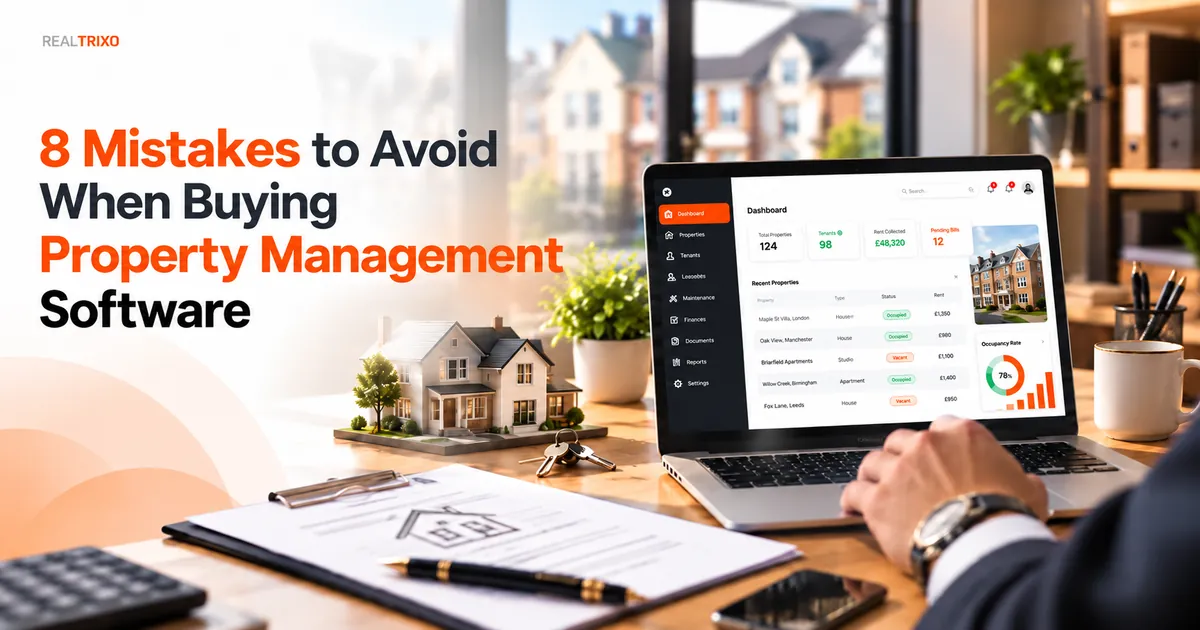
Today's digital era means an automation era in almost every industry. And the real estate industry is no exception. Property managers, independent landlords, and real estate investors have started buying property management software to streamline rental operations.
Industry analyses show that over 40% of real estate businesses fail to adopt core software capabilities after buying. It usually happens when industry professionals overlook certain factors and buy costly software that results in operational failures.
To avoid it, look at 8 major mistakes to avoid when buying property management software:
Unclear Goal About Your Needs
If you don't know your destination, no software can get you there. Before investing in technology, you must know exactly what you want to achieve. Like which daily headaches do you want to automate? How fast do you need results?
Skipping this step is the fastest way to waste money on the wrong tools. When you clarify your short-term needs and long-term goals upfront, you create a bulletproof strategy. It gives your software provider a clear roadmap to build or tailor the perfect system, ensuring the technology effortlessly scales alongside your growing business.
Extra Emphasis on Software Features
Choosing software based only on a flashy feature list is a trap. While features matter, the true success of your automation rests on what happens behind the scenes - specifically, scalable architecture, reliable maintenance, and lightning-fast customer support.
Before you sign a contract, treat the provider's website like a resume. Dig into their track record, case studies, and past performance. Most importantly, ensure the software’s DNA aligns perfectly with your specific business goals, because even the most advanced tool is useless if it doesn't fit your daily operations.
Non-Customized Software
If you are forcing your unique business into a generic, rigid template, it means you are inviting operational failure. While off-the-shelf software seems convenient, a surprising 90% of successful ERP implementations need at least one customisation to actually work effectively.
Relying on an out-of-the-box setup without third-party integrations or custom tweaks means your daily workflows will constantly clash with the software's limitations. You can leverage specialised integrations, like connecting powerhouse platforms Yardi or MRI with custom tools via experts.
Doing so helps you unlock missing features and force the technology to adapt to your business, rather than forcing your business to adapt to the technology.
Inadequate Staff Training
Even the most sophisticated software is completely useless if your team doesn't know how to run it. Buying a powerful new system and skipping comprehensive user training is a fast track to tanked productivity, data entry errors, and massive staff frustration.
When a team is left to figure out complex new tools on their own, they often reject the technology entirely and retreat to inefficient, old-school habits. Remember, successful automation needs a change in your company's culture, not just its software.
By prioritising thorough team training, you aren't just protecting your staff's workflow; you are boosting your bottom line. Data from HuffPost reveals that companies investing heavily in employee training enjoy a 24% higher profit margin.
Overlooking Software Scalability
Buying software that only fits your business today is a trap that will choke your future growth. Why? As your real estate portfolio expands, your transaction volumes, tenant data, and daily workloads skyrocket.
In such dynamics, a rigid, unscalable system will quickly collapse under that pressure. If you don't evaluate a platform's data capacity and scaling potential during the initial buying phase, you are setting a ticking time bomb for your operations.
Once you outgrow the system, you'll be forced to rip it out and start from scratch with an entirely new platform. It will waste massive amounts of time and capital.
So choosing a system designed to scale seamlessly ensures your technology effortlessly absorbs higher data loads, protecting your momentum as you conquer the market.
Ignoring Regular Software Maintenance
Thinking of automation as a set-it-and-forget-it project isn’t right. Otherwise, you will quickly leave your business behind. Software is never static. It needs continuous upgrades, routine bug fixes, and regular checkups to remain secure and aligned with your evolving goals.
Skipping routine software maintenance means your platform will eventually fail to adapt to emerging real estate trends, triggering costly system glitches, slow performance, and severe operational bottlenecks.
To keep your technology future-ready, smart companies partner with experts like RealTrixo for dedicated software health check services, ensuring your system continues to run like a finely-tuned machine rather than an outdated liability.
Flawed Data Migration
Treating data migration as an afterthought is the quickest way to infect your brand-new system with corrupt, broken information. Moving your historical tenant records, financial ledgers, and property data into a new platform needs meticulous cleanup and complex data conversion, yet many buyers rush this important phase.
The consequences are deepening. Like Bloor research by Philip Howard reveals that over 38% of data migrations fail, typically choked by messy source data and a total lack of structured conversion processes.
Failing to execute this transition flawlessly guarantees constant operational errors, phantom balances, and missing data from day one will affect your expensive new property management software.
To secure your business, smart operators leverage specialised business process outsourcing to ensure their data is scrubbed, mapped, and migrated with absolute precision.
Not Revamping Your Business Processes
Failing to redesign your outdated workflows before launching new software is like putting a rocket engine on a horse-drawn carriage. The real estate industry has historically clung to slow, traditional methods. However, property management software is meant to break those old habits, not automate your inefficiencies.
If you simply force modern technology to mimic your old manual paperwork, you completely choke its power. True automation needs a cultural shift. You must confidently strip away tedious manual data entry and adapt your business processes to thrive in a digital environment.
Approaching tech implementation with an open, flexible mindset isn't just a best practice. Instead, it is the ultimate prerequisite to unlocking peak operational efficiency and maximising your software ROI.
Conclusion
Transforming your real estate operations through automation doesn’t have to be a high-stakes gamble. By avoiding the above-mentioned 8 mistakes, you can protect your capital and unlock massive operational efficiency.
If the implementation process feels overwhelming, don’t go at it alone. Partnering with technology experts like RealTrixo ensures your software seamlessly aligns with your workflows from day one. Stop risking your operational efficiency and take control of your real estate automation today!